

By 1520 the hardest problems in European painting had been solved. Anatomy, proportion, linear perspective, the convincing weight of a body in a believable space — all of it worked, and everyone could see that it worked. Which leaves an awkward question for whoever comes next: what do you do after perfection? Mannerism is the answer a whole generation gave, and it is a stranger answer than art history usually admits. You do not try to be more correct. You become more elegant, more difficult, more knowingly artificial — and you let everyone see you doing it.
Where Mannerism sits in the story of art
Mannerism runs from roughly 1520 to about 1600, opening with the death of Raphael and the political catastrophe of the sack of Rome in 1527, and closing as the Baroque gathers. It follows directly on the High Renaissance, and it runs alongside the very different road taken in the lagoon by the Venetian Renaissance.
The name comes from the Italian maniera — manner, style, the way a thing is done. In the sixteenth century that word was praise: to have maniera was to have a recognisable and accomplished way of your own. Later centuries turned it into an accusation. To be “mannered” became a polite word for affected, decadent, a falling-off from a golden age. It took until the twentieth century for the period to be looked at again on its own terms, and for its knowing artifice to be read as the deliberate position it always was rather than as a failure of nerve.
It also travelled further than anything before it. Carried by Italian artists working at foreign courts — Fontainebleau in France, Prague under Rudolf II, the courts of Spain and the Low Countries — the maniera became the first genuinely international European style since the Gothic. For most of a century, a wall in Bohemia and a wall in Tuscany could speak the same visual language.
What actually defines it
Elongation, and the serpentine line. Limbs stretch, necks lengthen, fingers taper, heads shrink on tall bodies, and a slow spiral — the figura serpentinata — runs through the whole form so that nothing stands squarely at rest. Grace is preferred to correctness, and the stretch is not an error. It is the argument.
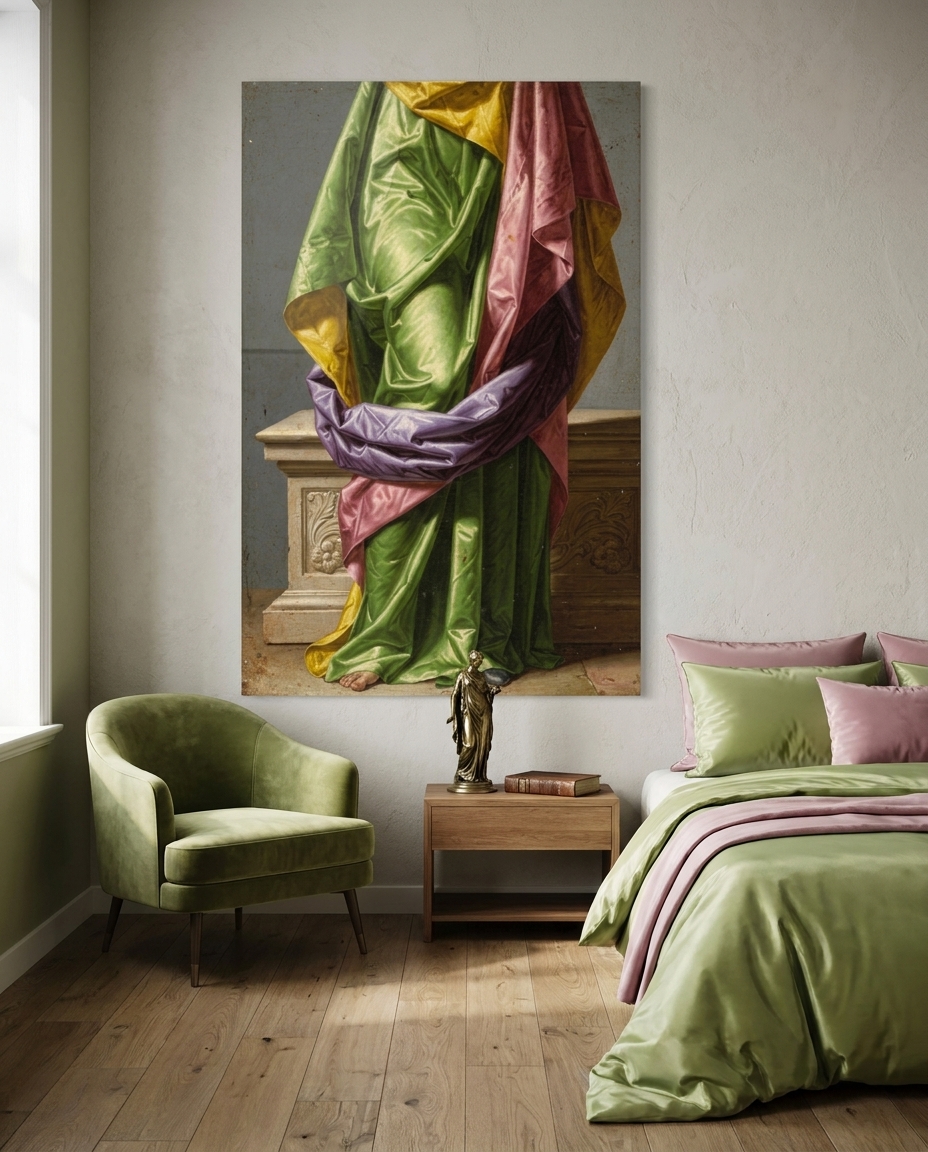
Shot, acid colour. Silk that changes hue as it turns: apple green shifting to rose, sulphur yellow to lilac, coral to cold blue. This is cangiante, and it is not the local colour of a real fabric. It is an effect, chosen because it is an effect — cool, sharp, faintly sour, and deliberately unlike the warm earth of the generation before.
Crowded, airless space. Compositions press forward against the picture plane and fill it edge to edge, with no restful ground and no comfortable middle distance. Where depth opens, it opens suddenly and steeply. The eye is given nowhere to settle, and that unease is designed.
A cold, hard surface. Oil on a smoothly primed panel, polished to something like porcelain or enamel, with crisply drawn contours and flesh modelled to the coolness of marble.
The rules quoted in order to be broken. Mannerist architecture is the clearest case. Triglyphs slip loose from a frieze, columns are sunk into a wall instead of standing before it, brackets carry nothing, pediments break and double. You need to know the classical grammar perfectly to enjoy watching it disobeyed, and that is exactly the audience the period wanted.
Ornament and the cabinet. Two more registers belong here and are too often left out: grotteschi, the weightless candelabra ornament of masks, garlands, ribbons and foliate scrolls that covered the period’s walls; and the goldsmith’s object — rock crystal, enamelled gold, nautilus shell, coral, ebony — made for the princely cabinet of curiosities, where the value of a thing was the labour visible in it.
The need
The gallery is walking chronologically through the whole history of art, one movement at a time, and Mannerism is the twenty-third station. It has a particular job in a collection of collections. Almost every earlier movement we have staged was, in its own mind, describing the world. Mannerism is the first that is openly about art — about style as something an artist chooses, performs and signs their name to. Skip it and the line from the Renaissance to everything self-conscious that follows simply breaks.
It is also the movement that decorators reach for without knowing its name. The elongated figure, the acid palette, the crowded frieze, the beautiful thing that is slightly wrong: this is a visual register that reads as sophisticated rather than merely historical, and it hangs in a contemporary room far better than its date suggests.
The production
Eight original works, invented from first to last. This is an homage to a manner, never a copy of a painting: no identifiable masterpiece is reproduced, no real person appears, no heraldry and no named building. The style is free — a style has never belonged to anyone — but a specific picture is not, and we do not go near one.
One curatorial decision deserves stating plainly, because it shapes the whole set. Mannerism’s most famous register is the twisting nude, and we did not go there. We built the collection instead on the court portrait, the robed crowd, drapery, ornament, unstable architecture, the garden grotto, the goldsmith’s object and the cabinet of curiosities — letting the serpentine twist be carried by cloth, by stone and by ornament rather than by bare bodies. Nothing is lost by it. These were never marginal to the period; they were its daily language, and they let the movement be told in full.
The production, seen work by work
The Cold Courtier is the portrait the period invented: a sitter of impeccable reserve, a very long neck, a small head, black silk slashed to show white satin, a stiff collar closed at the throat, and one long-fingered hand on a stone ledge. The face gives nothing away, and the refusal is the point.
The Procession on the Stair is the figural language at full strength — nine elongated figures in shot green, rose, yellow, lilac and coral, pressed forward on a shallow stair, crowding out to all four edges with no sky and no calm centre.
Cangiante takes the movement’s colour theory and makes it the entire subject: one fall of shot silk over a stone step, turning from acid green in the light to cold rose in the shadow, with a sulphur-yellow lining flashing where it folds back.
The Grotesque Wall is the ornamental register — candelabra ornament, garlands, carved masks, draped herms and perched birds on a crackled ivory ground, delicate and obsessively worked.
The Serpentine Stair is the architecture arguing with itself: an oval stair flowing downward like spilled water, columns sunk into the wall, brackets carrying nothing, a pediment broken over a blank door.
The Rusticated Grotto steps into the sixteenth-century garden — dripping tufa, a vault encrusted in shell and pebble mosaic, a carved stone mask spilling water into a dark basin, and a cold green light coming up off the water.
The Prince’s Nautilus is the cabinet object standing alone: a polished shell mounted in enamelled gold and strapwork on an ebony foot, with rock crystal and red coral beside it. Virtuosity as the whole content of the picture.
The Cabinet of Artifice closes the set with a still life of the period’s own preoccupations — a convex mirror swelling the room into a curve, a lacquered mask, kid gloves, coral, an hourglass, a marble sphere, on shot lilac silk.
The sale
Each work is offered as a print face-mounted behind acrylic glass, in ten sizes, on a wall-ready mount. The finish suits this movement unusually well: the acrylic surface gives back exactly the cold, polished, enamel-hard quality that Mannerist panels were built to have, and the deep shot colours hold their saturation across a room.
On placement, the eight divide cleanly. The portrait, the stair and the cabinet are study and library pictures — they reward being looked at closely and repay a quiet room. The procession, the drapery study and the grotesque wall are the colour pieces, and they carry an entrance, a bedroom or a salon on their own. The grotto and the nautilus are the dark ones, and they want a living room or a dining room with some evening light in it.
See the collection
The eight works are here: Mannerism.
Next in the chronological walk through art history: the Baroque, and the moment a single shaft of light out of the dark replaces all this cool, crowded elegance.