
There is an hour, in a northern room, when the sun stops climbing and starts crossing. It comes in low and sideways, lies down along the floorboards, catches the weave of a curtain, grazes a plastered wall, and dies in the corner it never reaches. Slow North is eight vertical works built entirely on that hour.
It is a collection about Scandinavian light and Scandinavian matter — pale pine and birch, unbleached linen, lime plaster, wool, matte stoneware, still water and snow — and deliberately not about the bleached, empty white that the word “Nordic” has come to mean on poster walls.
The need — the decorator’s eye
Buyers reach for “Scandinavian” more often than for almost any other style, and it was the one shelf of our gallery we could not answer. But the interior that asks for it in 2026 is not the interior of five years ago. Cool minimalism has lost its grip. Green has moved ahead of brown as the leading colour axis — mossy olives, mineral greens, deep teals. Wallpaper has taken back whole walls, ceilings included. Against a ground like that, a pale and polite picture simply disappears.
So the brief was warm-dark rather than bright-empty: a deep field of shadow across at least a third of every frame, one clear subject, and enough contrast to read from three metres away. These are pieces for the bedroom, the hallway and the entrance — rooms that want to enclose you rather than impress you. Hung alone above a bed or a console they hold a wall on their own; repeated as a pair down a corridor they give it rhythm.
The production — the art director’s vision
Every work in the series obeys one internal rule: a single fall of light crosses the frame. A band across floorboards. A halo through linen. A hard bar on plaster. A wedge of snow-light on bare pine. That recurrence is the collection’s private grammar — the thing that makes eight separate pictures unmistakably one body of work.
The rendering is analogue on purpose. Visible grain, halation blooming around every highlight, an atmospheric veil, edges that dissolve rather than snap, a slight drift in the colour. Nothing here is polished to a clinical finish, because a clinical finish is now the cheapest thing in the world. What is not cheap is surface you can feel: the tooth of paper, the open grain of wood, the slub of linen, the grit and trowel-marks of lime plaster, the sandy unglazed foot of a stoneware cup.
The palette holds to mineral greens with warm off-white and pale wood as ground and negative space, and allows exactly one warm counterpoint per work — a cognac, a rust — never enough to take over. No cold grey. No stark white. No people, no faces: only rooms, materials, and the world seen from inside one.
The sale — the gallerist’s word
What we are offering here is not technical perfection, and we would not sell it if it were. We are offering an intention and a series: a corpus that is legible, recurrent and recognisable, which is what actually carries a collection now. Buy one and you have a quiet, enveloping piece. Buy three and you have a wall that reads as a single decision.
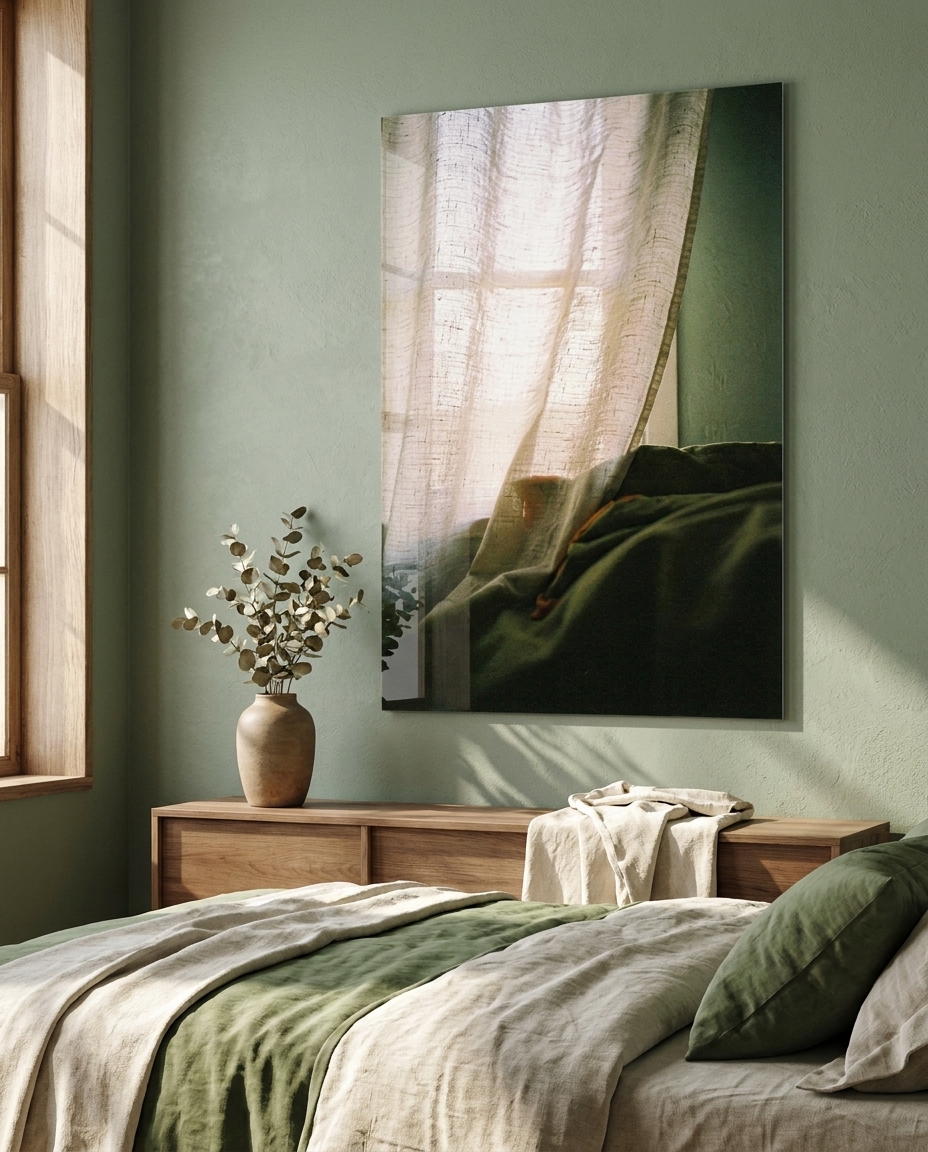
Each work is produced as a face-mounted acrylic glass print. The gloss is the point: a single lustrous surface in a room full of matte ones, and — the practical argument nobody makes often enough — a surface that throws light back into the dim, compact rooms where these pieces belong. Frame it thin and matte, in wood or dark metal, and let the picture do the rest.
The eight works
- Low Sun on Floorboards — a raking band of light across wide pale pine, dust suspended in the beam.
- Linen at the Window — an unbleached curtain lifting, backlit to a halo, olive shadow in the folds.
- The Birch Line — birch trunks through cold-fogged glass, the forest reduced to pale verticals.
- Plaster and Shadow — a lime wall taking the last light, one hard shadow bar across it.
- Still Water, Green — a northern lake in mineral green, framed by the darkness of a doorway.
- Wool and Bentwood — a folded blanket over a bentwood curve, one rust thread in the weave.
- Stoneware in Shadow — matte vessels on an oak shelf, a single glazed rim catching the light.
- Snow Light — the pale blue-white glow of snow laying a wedge of cold light on bare floor.
See the whole series here: Slow North.