Ninth in our chronological journey through the history of art — a gallery survey unfolding from the first cave paintings toward the present day. After the marble and mosaic of Rome, we travel east, to a civilization that learned to speak in metal, stone and script.
Where the story turns east
For most of the first chapters of this series we have followed the Mediterranean. But while Greek marble learned to breathe and Rome raised its arches, another of the world’s great artistic traditions was already thousands of years deep. Under the Shang, Zhou and Han dynasties — roughly 1600 BCE to 220 CE — the artists of ancient China created a visual language of astonishing sophistication and staying power: one so complete that its dragons, its jade symbolism and its written characters are still legible, and still moving, today.
This was an art of ritual and remembrance. Its masterpieces were not paintings on a wall but made things — objects cast, carved and lacquered for the service of the ancestors and the ordering of the cosmos.
Bronze, jade, bone and lacquer
The Shang bronzeworkers were among the finest metalcasters the world has ever seen. Their ritual vessels — the four-legged ding cauldron, the zun wine vessel — carry the enigmatic taotie, a frontal monster-mask surging out of a ground of fine spiral thunder-pattern. In jade, the Chinese found a stone worth a lifetime’s patience: the flat bi disc standing for heaven, the coiled dragon of good fortune, carved so thin the light glows through.
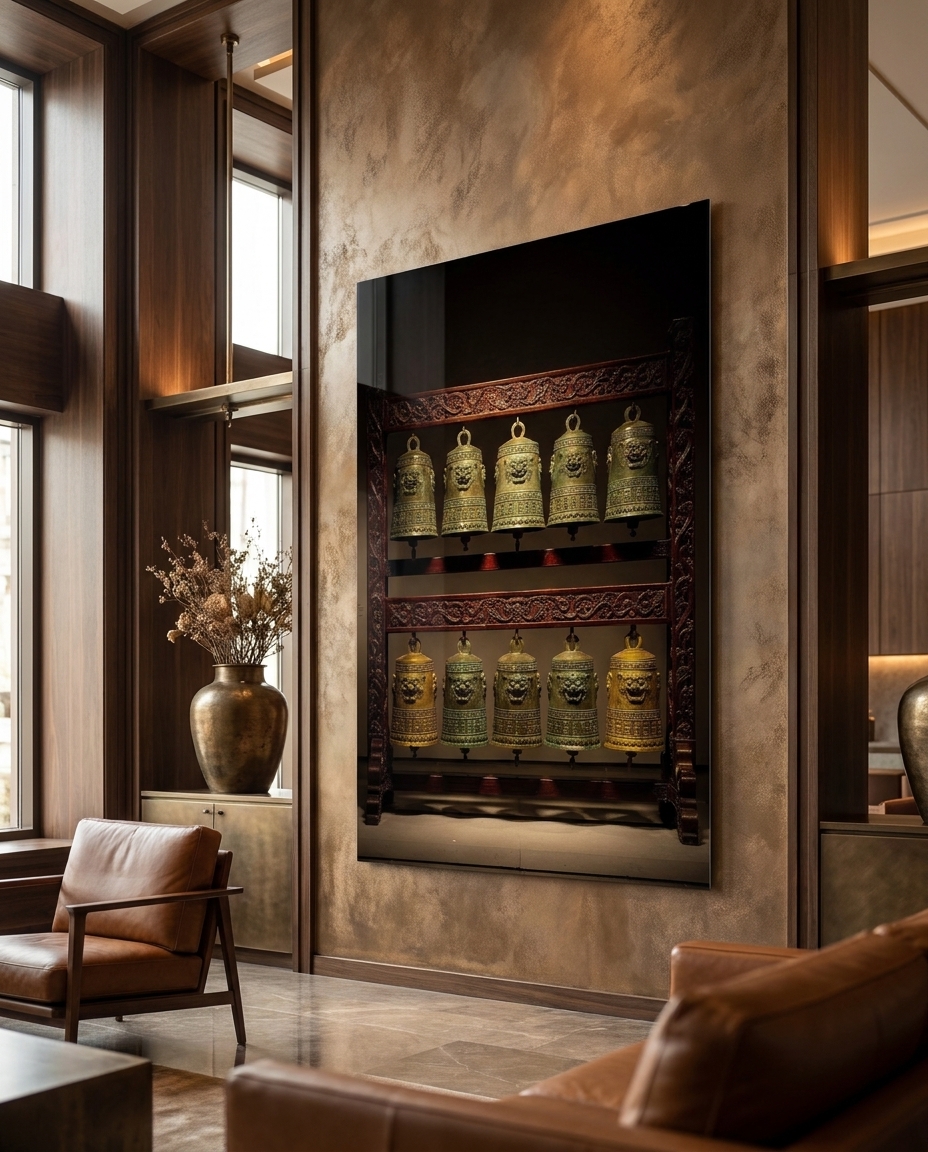
Above all, this is the age when writing itself takes form. On heated ox scapulae and turtle shells, Shang diviners incised their questions to the ancestors in the earliest Chinese script — the direct root of the characters a fifth of humanity still writes. By the Han, the confidence had spread everywhere: tuned bianzhong bells that were the orchestra of the court, glossy cinnabar-and-black lacquer painted with flying clouds, and bronze horses caught mid-stride with an anatomy so alive they seem to breathe.
The three experts on this collection
The need — the decorator’s eye
Interiors in 2026 have turned decisively toward warmth, depth and history: jewel tones, earthy grounds, and a single oversized statement piece that anchors a room. Ancient Chinese Art is made for exactly this moment. Verdigris green and gilt, cinnabar red against lacquer black, celadon jade glowing from within — these are grounding, collectible objects that reward slow looking. Give the ritual cauldron, the chime bells and the flying horse a tall, uncluttered wall; set the jade and lacquer studies against deep oxblood, teal or charcoal to make them snap forward.
The production — the art director’s vision
Rather than reproduce any single surviving relic, we imagined eight new objects in the spirit of the age and staged each as a museum still life — a treasure lifted from a tomb into a pool of raking light. The palette is disciplined and warm; the compositions are object-forward and unmistakably crafted. Every piece is an original homage: a Shang ding alive with monster-masks, a taotie relief in close study, a heaven-symbol jade on cinnabar silk, a coiled jade dragon, an inscribed oracle bone, a rack of ancestral bells, a Han lacquer cup and box, and a spirited gilt-bronze horse.
The sale — the gallerist’s word
Collectors today buy meaning and depth before they buy a name, and few subjects offer more of both than the foundations of Chinese art. Each work is printed and face-mounted under premium acrylic glass for museum clarity and true, anti-reflective depth, published by YTY Studio as part of a growing chronological gallery of art history. To live with one of these pieces is to keep a fragment of an ancient poise close at hand — an object that steadies a room and repays the eye a little more each day.
Explore the full collection here: Ancient Chinese Art — eight original works on premium acrylic glass.