There is a persistent misunderstanding about Islamic art: that its avoidance of the human figure was a constraint imposed on artists who would rather have painted people. The evidence suggests the opposite. Freed from the obligation to represent, artists from Cordoba to Samarkand poured a millennium of invention into geometry, pattern and surface — and produced some of the most intellectually demanding art ever made.
Infinity, worked out by hand
The girih star patterns that cover walls from Morocco to India are not decoration applied to architecture. They are mathematics made visible, centuries before the West described the same structures formally. A single panel implies its own continuation: the pattern does not stop at the frame, it merely goes out of view. To look at it properly is to understand that you are seeing a fragment of something endless.
The arabesque works the other way. Where geometry is rigid and crystalline, the arabesque is organic, scrolling, bifurcating and returning on itself, a vegetal line that never quite closes. Most great Islamic surfaces run both systems at once, one disciplining the other.
Light as a building material
Muqarnas — the honeycombed stalactite vaulting that fills domes and portals — exists to do one thing: break light into hundreds of small facets so that a solid ceiling appears to dissolve. The pierced marble jali screen does the same in reverse, turning a wall into a lattice that throws its own pattern across the floor and moves it through the day. Both treat light as a material to be carved.
The collection
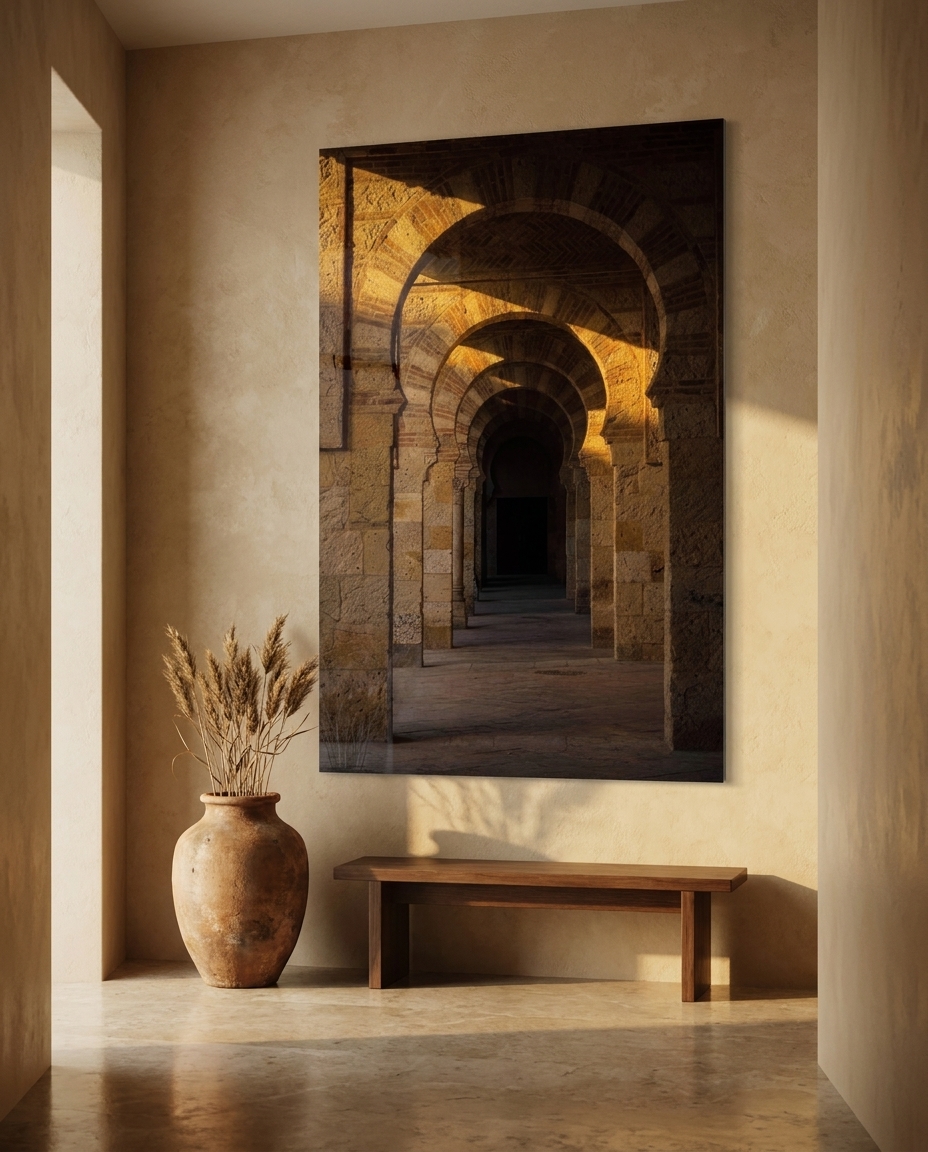
Eight original works in the tradition’s manner — no reproduction of any existing building or object, and no calligraphy: where line becomes script-like here it is pure ornament, never text. A cobalt star field. A muqarnas vault seen from below. A carved stucco arabesque. A jali screen and its cast shadow. A lustreware bowl. An inlaid brass ewer. A banded horseshoe arcade. A silk carpet medallion.
Living with it
Pattern of this density needs distance to resolve and proximity to reward — which makes these works unusually good in circulation spaces: a hallway, a landing, a long wall you walk beside. The cobalt-and-turquoise pieces lift cool, plain rooms; the brass and lustre pieces want warm light and will glow at dusk. Hang them straight and centred. Geometry notices when you don’t.