

Last time we stood in the warm, crowded rooms of Antwerp, where painting gave you more than you asked for. Cross the Pyrenees in the same century and the temperature drops. In Madrid, Seville and Toledo, painting went quiet: a few objects set apart on a stone ledge, a vast warm dark, one hard light from the left, and an obstinate respect for the plain truth of a clay jar, a wool habit or a human face. The Spanish Golden Age is the art of saying less, and meaning every word.
Where the Spanish Golden Age sits in the story of art
The Siglo de Oro of Spanish painting runs roughly from 1590 to 1680. It is the exact contemporary of the Flemish Baroque and of the Dutch Golden Age, and it belongs to the same great family as the Roman Baroque: the dramatic single light, the figures emerging from darkness. But Spain took that light somewhere else entirely.
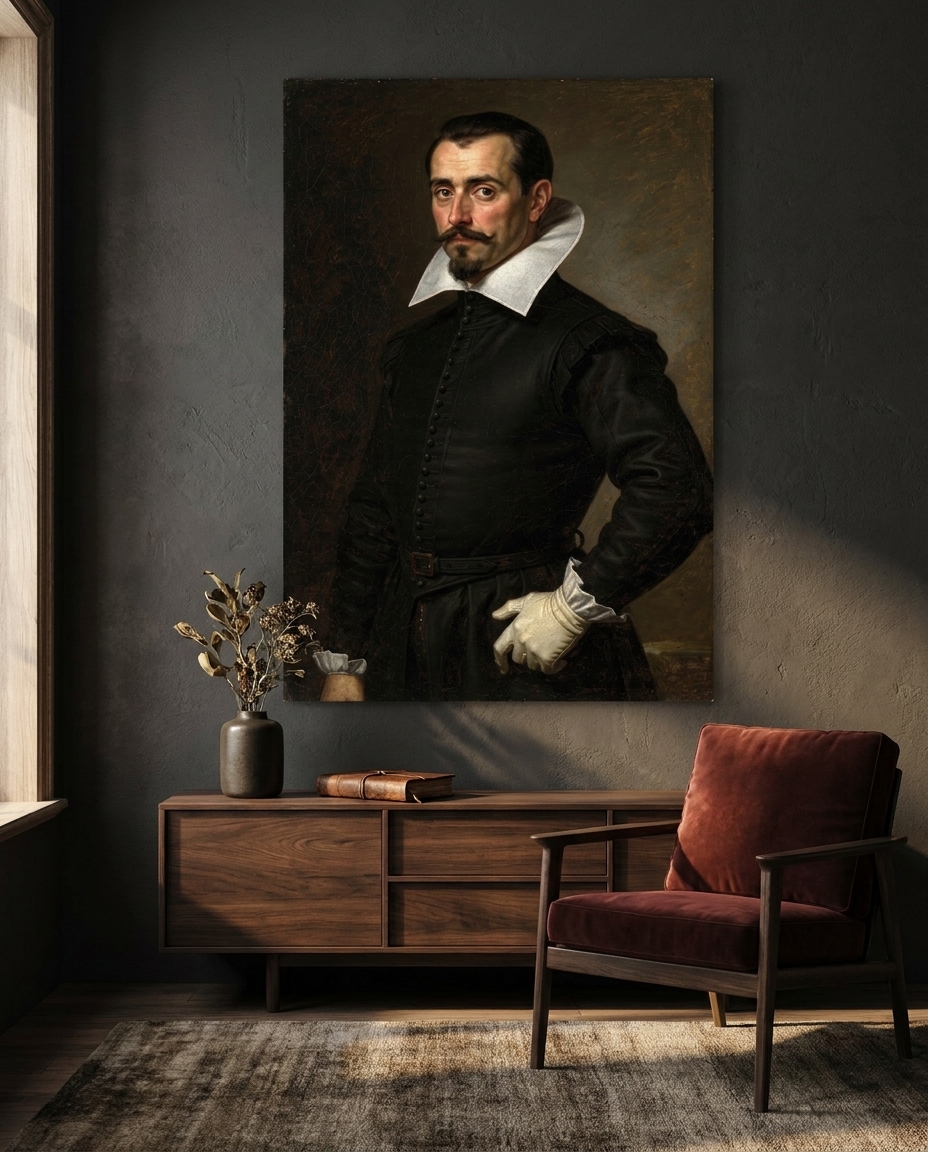
Two forces shaped it. The first was the Church of the Counter-Reformation, which asked painting to move the soul through truth rather than splendour — hence monastic orders commissioning grave, silent images of prayer and work for their cloisters. The second was the court in Madrid, where portraiture became an art of restraint: black cloth, a stiff white collar, a steady gaze, and almost nothing else. Between the two grew a Spanish speciality, the bodegón: the kitchen or pantry still life, a handful of humble things arranged with an almost mathematical calm.
Its influence reached far beyond its century. The sober Spanish portrait and the loose, suggestive brush of the Madrid court were rediscovered with astonishment by nineteenth-century painters, and the austere still life, with its empty dark and measured intervals, still speaks directly to anyone who loves minimal, architectural design.
What actually defines it
The dark is the subject. A deep, warm black fills most of the picture, and one lit passage emerges from it. Emptiness is used on purpose, never filled to be polite.
One raking light. A single hard light enters low from the left, grazes across the form, throws long exact shadows and leaves the far side of every object in true black. It is tenebrism, but cool and sober rather than theatrical.
Economy of objects. Four things on a ledge, spaced apart, each given the same grave attention. Interval and geometry matter more than abundance.
Material truth. Unglazed terracotta, coarse undyed wool, rough linen, hammered copper, dusty fruit skin, cold water in glass — painted with a plain, unsentimental, almost stubborn realism.
A restrained palette. Warm blacks and bitumen browns, bone white and ivory, clay ochre, lead grey and silver, with one restricted accent: oxblood, amber, or the dull crimson of a curtain.
The need
After the full orchestra of Antwerp, our three experts wanted silence. There are rooms that need exactly that: a dining room that should feel calm rather than festive, a study or a library that wants gravity, a minimalist hallway or a bedroom where one quiet, deep picture does more than a busy wall ever could. These works hold a wall by being still on it, and their high contrast reads clearly from across a room.
The brief kept every sitter an invented adult, dressed from collar to shoe in wool, linen or satin, and every composition original: no known portrait, no identifiable monastery, no quotation of a famous canvas. The eight subjects map the period’s own repertoire — the hanging window-niche still life, the water jar, the kitchen piece, the monastic figure, the court lady, the gentleman in black, the empty cloister and the workshop scene.
The production
The art direction fixed one language for the whole set: oil on canvas, smooth and velvety in the darks, crisp and dry-loaded in the highlights, one cold raking light, fine age craquelure and a mellow darkened varnish. Every master then went through the studio’s quality control. Paintings in this manner tend to arrive with invented signatures tucked into a lower corner, and each one was located and cleaned by hand before the works were placed in their rooms for the shop. Hands, always the hardest part of a portrait, were checked one by one.
The production, seen work by work
The Hanging Quince is the window-niche still life at its most austere: a golden quince and a green cabbage suspended on fine strings inside a pale stone recess, a cut melon on the sill, and absolute black behind.
The Water Jar finds poetry in necessity: a large unglazed earthenware jar beaded with cold condensation, a clear glass of water before it and a folded grey linen cloth, on a plain dark table.
The Kitchen Table is the kitchen piece: a hammered copper pan, a yellow-glazed mortar and pestle, a head of garlic, brown eggs in an earthen bowl and a tall clay pitcher, caught by daylight from a high window.
The White Habit turns cloth into architecture: a solitary friar in heavy undyed white wool, hands hidden in his sleeves, face shadowed by the hood, the folds carved by the light of an unseen candle against a lime-washed wall.
The Infanta’s Silver brings in the court: an invented noblewoman in a wide silver-grey satin gown with lace at the wrists, one hand resting on a velvet-covered table, a muted crimson curtain and a dim palace chamber behind her.
The Black Doublet answers it in the Spanish colour of prestige: an invented gentleman in matte black wool and a stiff white linen collar, a pale glove at his hip, against a warm grey-brown void with no emblem at all.
The Cloister at Noon is the only picture without a figure: a whitewashed arcade over worn ochre flagstones, hard Castilian midday light cutting sharp shadows across the walk, a stone well and one open door of dark wood.
The Weavers closes the set with a workshop scene: three women in coarse wool and linen at a great wooden spinning wheel, winding and sorting yarn in a shaft of golden light from a high window, the room falling away into brown dark.
The sale
Each work is offered as a print face-mounted behind acrylic glass, in nine sizes, ready to hang. This movement suits the finish remarkably well: the glossy face deepens the blacks until they seem bottomless, and makes the lit passages — a bead of condensation, the white wool of a habit, the silver of a satin gown, a glint on copper — stand out with an almost physical presence.
These are pictures for calm, considered rooms. The quince, the water jar and the kitchen table belong in a dining room or a kitchen, above a sideboard or a long bench. The two court portraits bring quiet authority to a study, a bedroom or an office, and they hang beautifully as a pair. The white habit wants a library or a reading corner; the cloister opens up an entrance hall; the weavers bring warmth to a living room or a studio. Pair them with oiled dark wood, lime plaster, linen, wrought iron and terracotta, give them space around the frame, and light them with a single focused spot, exactly as the painters lit their subjects.
See the collection
The eight works are here: Spanish Golden Age.
Next in the chronological walk through art history: the Rococo, where the eighteenth century lightens everything — pastel skies, curling ornament and a new taste for grace and play.